These techniques will help you relax the body. We give them here as a preparation for meditation, but they can be used at any time. They take only a few minutes.
Full Yogic Breath
This technique relaxes the spine and helps to increase and harmonize the energy in the body. It also oxygenates the brain. Stand erect with feet slightly apart and hands at your sides. Concentrate first on standing with proper posture—spine straight, chest up, and chin level with the floor—the same posture you learned for meditation in the last lesson. Close your eyes and feel that you are centered in your spine. Now, without any strain, raise your arms above your head. Slowly bend over, bringing your hands toward your toes while exhaling gradually as you do so. Only go as far as is comfortable. By the time your hands have reached their lowest point you should have exhaled all the air in the lungs.
Let the hands rest on your ankles or, if you are flexible enough, touch the floor. Rest in this position for a few moments.
Now begin to inhale through the nose and come up gradually until you are fully erect. Bring your hands up slowly as you rise and extend them once again over your head. Rise up on your toes as you complete this upward movement. You should
inhale slowly during the whole rising motion, filling your lungs completely by the time your arms are above your head. Now, finish the movement by exhaling slowly through the nose and once again bringing the hands to the sides. Repeat this sequence three to five times, trying to breathe more and more deeply each time. When you finish, stand erect for a minute or two with your eyes closed. Feel that your body is completely relaxed and filled with energy.
In order to do the full yogic breath correctly, you need to breathe very deeply. Begin the inhalation, as you rise, by breathing with your diaphragm (diaphragmatic breathing is taught next). Then, as you rise farther, inhale more deeply, feeling the sides of your chest and rib cage expanding and filling the middle part of your lungs with air. Finally, as you stretch up, fill the upper part of the lungs. Feel that you are
filling not only your lungs, but your whole body with air and vitality.
Diaphragmatic Breathing
It is important to learn how to breathe correctly, and this means diaphragmatic breathing. The diaphragm is a dome-shaped muscle between the lungs and the abdominal cavity. As we inhale, it contracts and flattens its curve, creating a vacuum into which the lungs can expand. As this happens the diaphragm pushes the abdominal muscles outward. Watch the stomach of a baby rise and fall as it breathes and you will see this natural process in action. Many adults, however, because of tension, illness, or the desire to have a thin waist, resist this natural movement and have to re-learn it.

Diaphragmatic breathing can, and should, be done in any position, but it is easiest to learn when you are most relaxed, lying on the floor. Lie on your back with your arms at your sides, palms upward. Some people find it easier to relax the diaphragm if they bend their knees, placing their feet flat on the floor. Relax completely, especially the stomach and abdomen. Now, breathe deeply and slowly, concentrating on the diaphragm, and feeling your stomach rise as you inhale and fall as you exhale. Relax the abdominal muscles more and more completely, using the diaphragm, and not the
stomach muscles, to create the rise and fall of the abdomen.
Breathe always through the nose and not the mouth unless specifically instructed otherwise. The movement of air, filtered through then nostrils, has a cooling effect upon the brain and leads to greater mental clarity whereas habitual breathing through the mouth is associated with dull-mindedness.
After several minutes of practice on the floor you can sit in a cross-legged position and continue diaphragmatic breathing. You may find this a little harder at first but you’ll soon catch on. It helps to close your eyes and concentrate on relaxing the
stomach, allowing it to swell outward and relax back inward. Once you know how to breathe correctly you can practice diaphragmatic breathing wherever you are. It may take a couple of weeks to re-train yourself but you will find the results well worth the effort. Be sure to check to see that you are breathing diaphragmatically as you begin your meditations.
Tensing and Relaxing
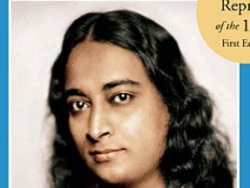
This technique was recommended by Paramhansa Yogananda and will help release subconscious tensions. It is especially valuable for meditation and should be used at the beginning of each session. You can also use it at the beginning of deep relaxation or any time you feel tense. To begin, inhale fully through the nose with a “double breath.” A double breath is a short inhalation followed immediately by a long inhalation—huh, hhuuuuhh. When you have inhaled tense the whole body until it vibrates, holding the breath as you do so. Then throw the breath out and relax completely.
This exhalation should be with a double breath through both the mouth and nose to quickly expel the air. Doing this three to six times will help rid the body of unconscious tensions. Now, consciously relax the various body parts, starting with your feet and working your way gradually to the head and brain. It may help you to visualize space or light filling each area as you relax it. Physical relaxation is the first step necessary for deep meditation.
Measured Breathing to Relax the Mind
The breath is intimately linked with the mind. By controlling and relaxing the breath, we influence the mind to become calm. This technique will regularize and harmonize the breath, which, in turn, will produce the same result for your mind.
Inhale slowly, counting to eight. Hold the breath for the same eight count while concentrating your attention at the point between the eyebrows. Now exhale slowly to the same count of eight. This is one round of “regular breathing.” Depending upon your capacity, you can go more slowly, counting mentally to 12,12, 12 or 16,16,16. It is essential that the inhalation, holding, and exhalation be of equal length and, generally speaking, slower is better, but don’t go so slowly that you get out of breath. That would be counterproductive.
As you do this technique feel that you are becoming increasingly relaxed and focused.
Releasing Emotional Tension
This practice can also help us to achieve release from mental and emotional pain. The stress that accompanies such pain usually produces physical tension. By relaxing the body, as outlined above, then extending the thought of physical relaxation to the release of tension in the mind and in the emotions, we can achieve mental and emotional tranquility with the release of tension in the body.
Whenever you feel anxious or fearful about anything, or distressed over the way someone has treated you, or upset for any reason, inhale and tense the body. Bring your emotions to a focus in the body with that act of tension. Hold the tension briefly, vibrating your emotions along with the body. Throw the breath out, and, keeping the breath exhaled as long as you can do so comfortably, enjoy the feeling of inner peace. Remain for a time without thought.
When the breath returns, or when thoughts once again bestir themselves in your mind, fill your brain with some happy memory that will provide an antidote to your emotions. Concentrate for several minutes on the happiness of that memory.
Throughout this process, look upward, and mentally offer yourself, like a kite, into the winds of inner freedom. Let them sweep you into the skies of superconsciousness.